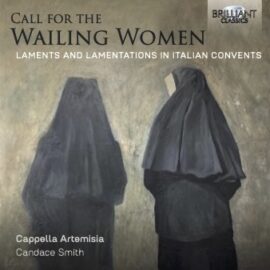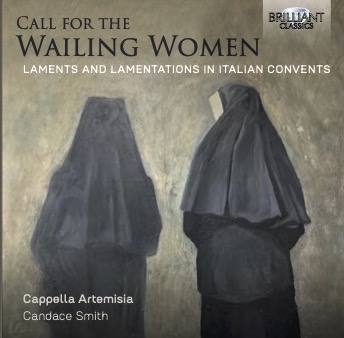
Call for the mourning women, […] that our eyes may run down with tears, and our eyelids gush out with waters. (Jeremiah, 9:17-18)
Call for the Wailing Women
Laments and Lamentations in Italian Convents
Call for the mourning women, […] that our eyes may run down with tears, and our eyelids gush out with waters. (Jeremiah, 9:17-18)
The Lament has been associated with women since time immemorial. From the book of Jeremiah to Ovid’s Heroides to Mediterranean folk traditions, mournful weeping has long been the prerogative of women. Moreover, the lament was a socially acceptable outlet for female eloquence in a society and a Church that instead dictated silence and subjugation.
This recording presents laments and lamentations from 16th- and 17th-century Italy as they might have been heard in that most exclusively female environment: the convent. It includes works composed both by and for cloistered nuns, and features a number of different settings, both monodic and polyphonic, of the very expressive text of the Lamentations of Jeremiah.
This program, featuring nine voices, violin and basso continuo (15 musicians), presents the exquisitely female genre of the lament within the context of the female world of the convent, and it explores though music the many roles open to women’s voices: mother, bride, nun, artist.
Il disco è uno scrigno di preziose registrazioni in prima mondiale di mottetti di compositori poco conosciuti del primo barocco italiano. […]A brani monodici, di una lancinante semplicità, se ne aggiungono altri che richiedono stupefacenti doti nel canto. Le candele lentamente si spegneranno e queste voci femminili aleggeranno nella chiesa buia, con tutto il loro carico di dolore.
Chiara Sirk, Bologna 7, 29 Mar. 2026
Queste coraggiose e raffinate interpreti proseguono infatti il loro prezioso lavoro di ricerca, studio ed esecuzione del tesori musicali custoditi nel monasteri femminili tra XVII e XVIII secolo. […] È questo il terreno ideale sopra cui le componenti di Cappella Artemisia mettono in gioco la loro magistrale sensibilità interpretativa.
Andrea Milanesi, Avvenire
Wailing Women and Italian Convents
Throughout the album, the voices are warm, the text audible, and the emotion clearly centered. I particularly appreciate how the lower voices are so delightfully foregrounded and resonant throughout.
Karen M. Cook, Early Music America, May 10, 2026
Adieu, Spinett und Chitarrone?
Solce Musik hätten Giacomo Carissimi und Claudio Monteverdi nicht ausdrucks-stäker erdenken können. […] Fazit: Musik auf der Höhe der Zeit hat nicht vor Klostermauern Halt gemacht, und der Qualitätsanspruch war innerhalb der Klausuren nicht gering. Die Damen der Capella Artemisia sind auf den Stil engeschworen. Kein übertriebener Affekt, kein falsches Vibrato, perfekte Auszierungen. Gerade das Unaffektierte macht den Affekt.
Rienhard Kriechbaum, Concerto n. 317, 2026
[…] Nel complesso, il suono è limpido, dolce, d’una sacralità all’apparenza più tardo-medievale che rinascimental-barocca: felicissimamente.
Piero Mioli, Amadeus, luglio-agosto 2026
(2025 by )
Call for the Wailing Women Laments and Lamentations in Italian Convents Call for the mourning women, [...] that our eyes may run down with tears, and our eyelids gush out with waters. (Jeremiah, 9:17-18) Call for the Wailing Women Laments and Lamentations in Italian Convents Call for the mourning women, [...] that our eyes may [...]